
— Building a new three-dimensional urban fire prevention and control system in the digital age
Introduction: City Fires, Safety Questions
In the context of rapid urban development, buildings are becoming increasingly dense and complex, and electricity and gas consumption is continuously rising. Traditional fire management models are facing unprecedented challenges. Delayed information transmission, untimely fire detection, asymmetric rescue information, inefficient facility management, and difficulty in ensuring accountability… these pain points all point to a grim reality: we urgently need a “smart revolution” in fire safety.
In the past, traditional building fire protection facility monitoring relied mainly on manual inspection and simple alarm systems. Firefighters or maintenance personnel had to conduct regular on-site inspections to check the condition of fire extinguishers, fire hydrants, smoke detectors, and other fire protection equipment. This traditional method has several drawbacks. First, the limited frequency of inspections may lead to the failure to detect equipment malfunctions or shortages in a timely manner. Second, the accuracy of manual inspections is highly dependent on the professional level and responsibility of the inspectors, and human error is inevitable.
Because building fire safety management relies heavily on manual inspections, regular maintenance, and decentralized systems, the main problems with traditional maintenance are:
• Ineffective maintenance: Equipment inspections are scheduled at fixed intervals, resulting in malfunctions that go undetected between inspections (e.g., expired fire extinguishers, faulty alarms).
• Human error: In emergency situations, manual processes are prone to oversights, incomplete records, or delayed responses.
• Observational limitations: Isolated systems (such as alarms and sprinklers) operate independently, without a unified view of overall fire safety and health.
• High costs: Frequent physical inspections and emergency repairs consume resources, while the risk of non-compliance can lead to legal penalties or insurance disputes.
These issues have created serious management loopholes. Aging infrastructure, unnoticed faults, or human delays often escalate minor problems into catastrophic events that endanger lives, damage assets, and disrupt operations.
The new generation of smart fire protection IoT integrated solution deeply integrates cutting-edge technologies such as IoT, big data, cloud computing, artificial intelligence (AI), and geographic information system (GIS). It aims to break down information silos, reshape fire management processes, and transform “passive response” into “proactive anticipation.” It builds a three-dimensional fire prevention and control system for cities that covers all time, all space, and all elements, safeguarding the peace and tranquility of every inch of space.
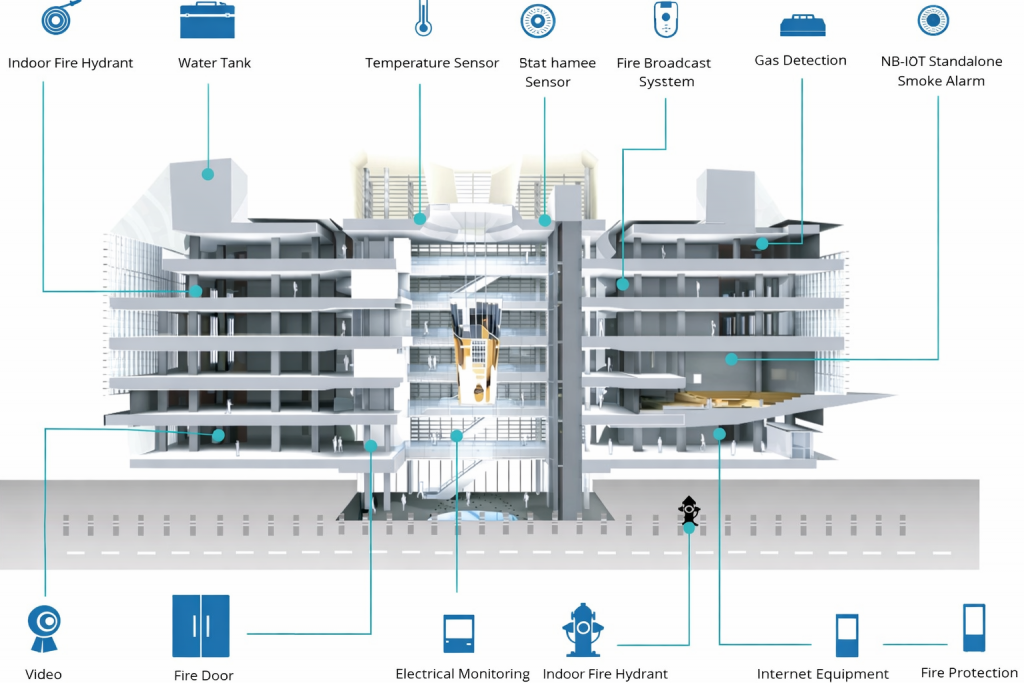
Significance and role
- Proactive risk management: Continuous monitoring eliminates blind spots between manual inspections, ensuring that faults can be detected immediately (e.g., low water pressure in fire extinguishers, malfunctioning alarms).
- Faster emergency response: Real-time alerts enable stakeholders to take action within seconds, coordinating evacuation efforts and mobilizing fire resources before the disaster escalates.
- Resource optimization: Predictive maintenance reduces unnecessary inspections, extends equipment lifespan, and can reduce operating costs by up to 30%.
- Regulatory safeguards: Automated compliance reporting simplifies the audit process, reduces legal risks, and insurance companies also view IoT-enabled buildings as lower-risk assets.
- Scalable security: This solution is suitable for a wide range of infrastructures, from old building complexes to smart buildings, providing future protection for fire safety investments.
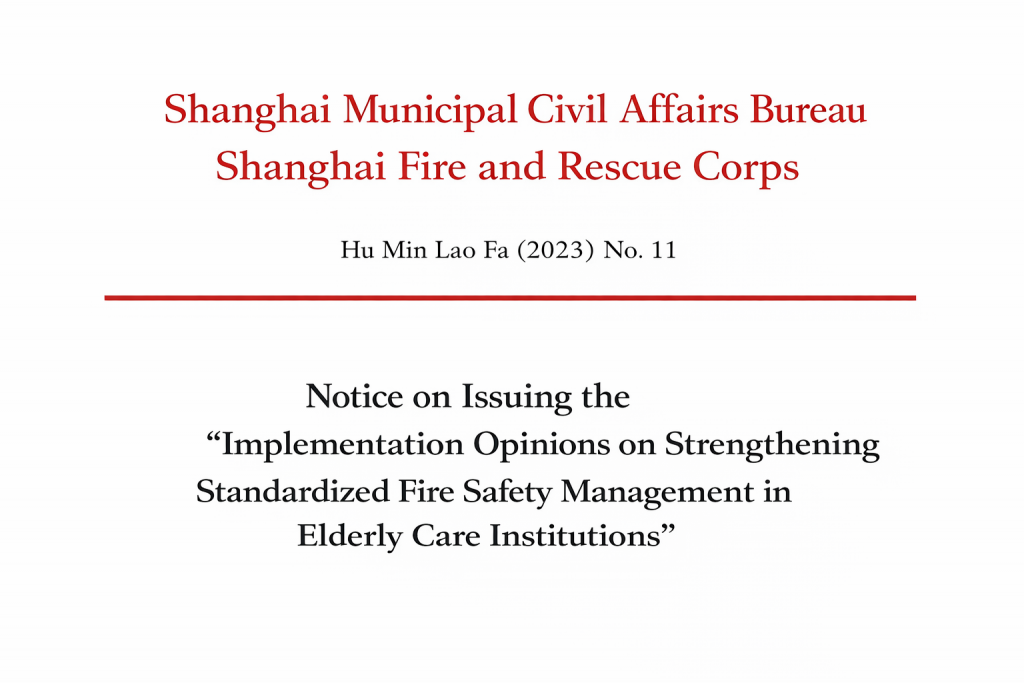
Starting in 2022, Shanghai has been required to prioritize the networking of two types of buildings: “commercial complexes with an area of over 30,000 square meters” and “Class A high-rise public buildings.” This aims to further utilize Internet of Things (IoT) technology to comprehensively monitor the operational status of fire protection facilities, provide technological means for social units to improve their fire safety management, offer risk identification for key targets of government and industry departments at all levels, and provide data support for fire prevention, firefighting, and emergency rescue by fire and rescue agencies.
In 2023, Shanghai issued a document requiring elderly care institutions equipped with fire-fighting facilities such as automatic fire alarm systems, fixed fire extinguishing systems, and smoke control systems to set up fire-fighting facility IoT systems in accordance with national engineering construction fire protection technical standards, and to transmit monitoring information to the municipal fire data docking platform in real time; other elderly care service institutions are encouraged to set up fire-fighting facility IoT systems.
Wider impact
Beyond immediate safety benefits, this IoT-driven transformation fosters resilient and sustainable urban ecosystems. It enables organizations to protect human lives, maintain economic value, and uphold reputational integrity in an era of heightened fire risks due to climate change and denser urban landscapes. By combining technology with safety, this solution redefines fire preparedness as a strategic priority rather than a regulatory obligation, setting a new standard for modern infrastructure management.
Smart fire protection is not just a technological innovation, but also an elevation of safety concepts. We are committed to using the power of technology to enable every potential crisis to be anticipated in advance, and to make every emergency response more precise and efficient. Choosing a smart fire protection IoT solution means choosing a safer, smarter, and better future. Let us join hands and use the light of wisdom to illuminate the safety of every household in our city.





Leave a Reply